
产品性能介绍
Industrial facilities and commercial workshops are increasingly switching from painted steel to blue molded fiberglass grating (FRP grating). The distinctive blue color delivers clear zoning and high visibility. At the same time, the composite matrix prevents rust, chemical corrosion, and electrical hazards.
This technical guide reviews structural specifications, resin selections, load performance, and primary application sectors for blue FRP grating.
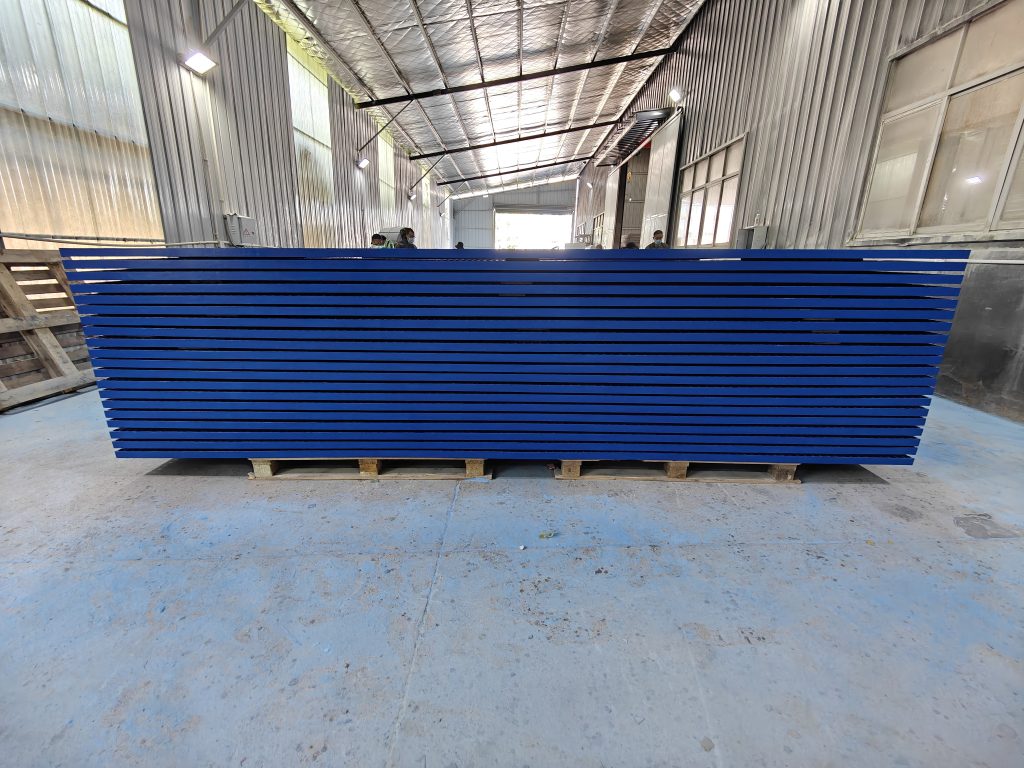
What Makes Blue FRP Grating Unique?
Blue FRP grating is a one-piece molded composite panel. Continuous wet fiberglass rovings cross through a heated mold with thermosetting polyester or vinyl ester resin.
Unlike steel grating with superficial blue paint, blue FRP grating features integral pigmentation. Color pigments blend throughout the entire resin volume during mixing.
This through-body color delivers practical advantages:
- No Chipping or Peeling: Scratches and surface abrasions never expose bare carbon steel or contrasting base coats.
- UV Resistance: Formulations contain organic UV blockers that slow down solar degradation and surface chalking.
- Visual Safety Coding: In industrial engineering, blue traditionally designates clean water streams, washdown stations, and safety walkway corridors.
Integral coloring also eliminates regular painting shutdowns. Painted steel in wet environments requires repainting every two to three years. In contrast, solid-pigment blue fiberglass retains its visibility and identification value for decades without maintenance. Plant managers save both labor costs and operational downtime.
Surface Texture and Slip Resistance
Slip resistance is essential for wet and oily workspaces. The factory images below show the authentic concave meniscus profile.
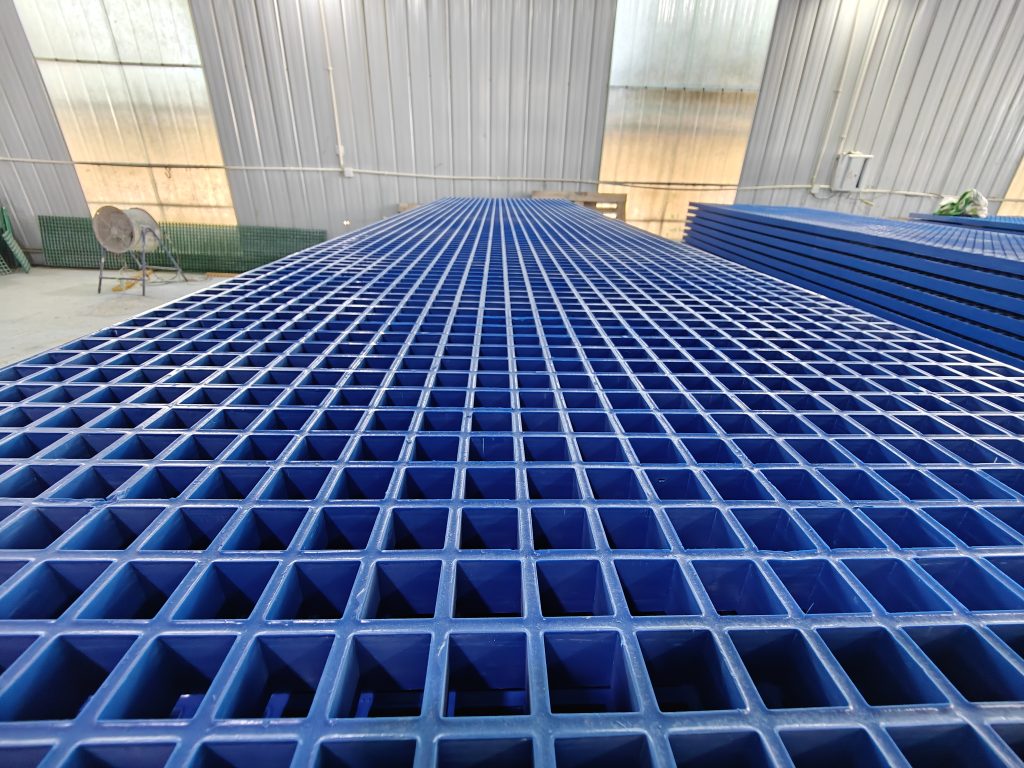
Meniscus Top Surface
During the mold cooling cycle, the liquid resin shrinks slightly at the bar top. This physical contraction leaves a natural concave crest along every bearing bar.
The meniscus edge provides dependable multidirectional traction. Because it contains no loose bonded grit particles, it is easy to clean with high-pressure water hoses. This cleanability makes it the top choice for commercial car wash bays and food packaging facilities.
Embedded Quartz Grit Option
For extreme slip hazards with heavy grease or engine oil, fabricators apply angular quartz sand under an extra resin lock-coat. Gritted blue grating achieves a DIN 51130 R13 rating and a dynamic coefficient of friction above 0.85 per ASTM C1028.
Technical Specifications and Standard Dimensions
Standard production runs follow standardized metric and imperial mesh configurations.
| Parameter | Standard 25 mm Depth | Standard 30 mm Depth | Heavy-Duty 38 mm Depth | Test Method |
|---|---|---|---|---|
| Panel Thickness | 25 mm (1.0 in) | 30 mm (1.2 in) | 38 mm (1.5 in) | Calliper Check |
| Mesh Pattern (C-to-C) | 38 × 38 mm | 38 × 38 mm | 38 × 38 mm | ISO Standard |
| Open Area | 68% | 68% | 68% | Optical Calculation |
| Unit Weight | ~12.3 kg/m² | ~14.6 kg/m² | ~19.5 kg/m² | Factory Scale |
| Glass Content (wt%) | 32% – 35% | 32% – 35% | 32% – 35% | ASTM D2584 |
| Tensile Strength | 200 MPa | 205 MPa | 210 MPa | ASTM D638 |
| Flexural Strength | 260 MPa | 275 MPa | 280 MPa | ASTM D790 |
| Barcol Hardness | > 40 | > 42 | > 45 | ASTM D2583 |
| Flame Spread Index | ≤ 25 (Class 1) | ≤ 25 (Class 1) | ≤ 25 (Class 1) | ASTM E84 |
Stock panel dimensions measure 1220 × 3660 mm (4 × 12 ft), 1220 × 2440 mm (4 × 8 ft), and 1000 × 4000 mm. Custom cut-to-size panels can be ordered with factory-sealed edges.
Load and Deflection Performance
Molded blue FRP grating provides bidirectional load distribution. Bearing bars run equally in both horizontal axes, which simplifies on-site cutouts around pipes.
Safe Uniform Load Guidelines
Per the ANSI/ACMA FGM-2003 manual, industrial walkway design relies on a maximum deflection limit of L/120 or 9.5 mm (0.375 in).
- 24-inch Span (610 mm): A 38 mm deep panel carries up to 800 psf (38.3 kN/m²) uniform load with a 5:1 ultimate safety factor. At standard 100 psf pedestrian load, center deflection remains under 1.0 mm.
- 36-inch Span (914 mm): A 38 mm deep panel carries 350 psf (16.7 kN/m²), easily exceeding OSHA walkway load criteria.
Resin Formulations: Choosing the Right Grade
The composite resin sets chemical durability and temperature boundaries.
Orthophthalic Resin (Economy / Commercial Grade)
- Service Rating: Mild atmospheric conditions and routine washdown environments.
- Primary Use: Commercial car wash floors, auto repair drainage trenches, and decorative architectural screens.
- Continuous Temperature: Up to 60 °C (140 °F).
Isophthalic Polyester (Industrial Standard)
- Service Rating: Moderate mineral acids, salts, municipal sewage, and outdoor sunlight.
- Primary Use: Municipal water treatment facilities, aquaculture farms, and cooling tower walkways.
- Continuous Temperature: Up to 80 °C (176 °F).
Vinyl Ester Resin (Severe Chemical Grade)
-
- Service Rating: Concentrated hydrochloric acid, sulfuric acid, and strong alkaline oxidizers.
- Primary Use: Chemical storage tank bunds, chlor-alkali production lines, and marine battery rooms.
- Continuous Temperature: Up to 105 °C (221 °F).
Primary Application Scenarios for Blue FRP Grating
The blue color profile combined with corrosion resistance serves multiple sectors.
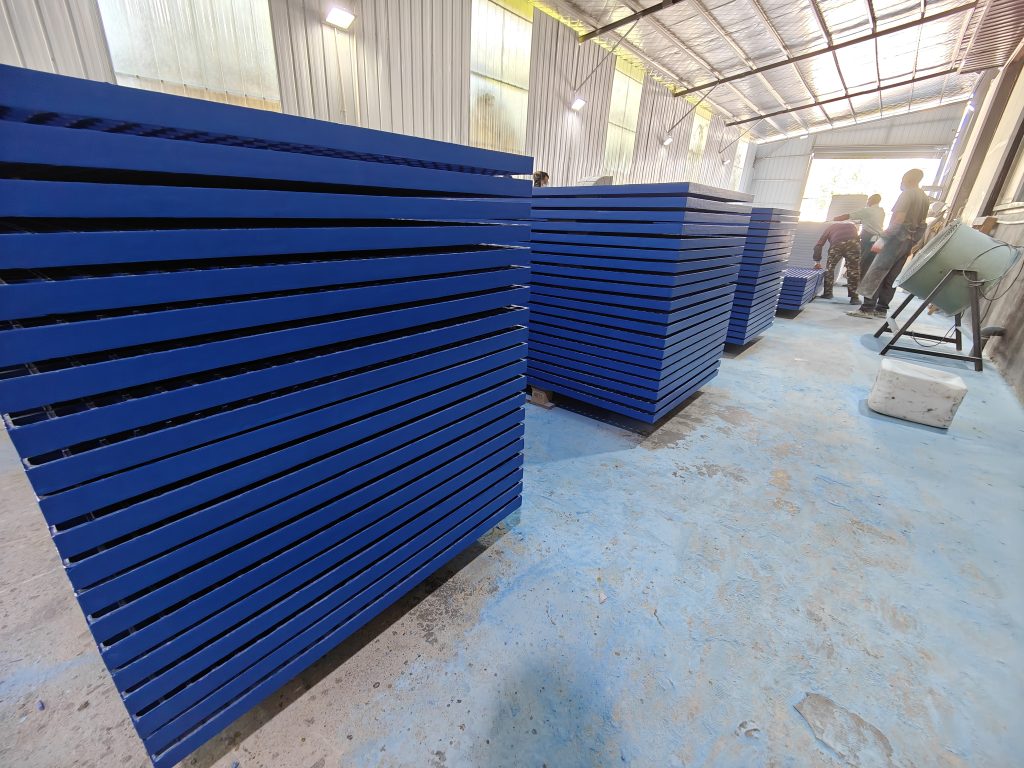
1. Commercial Car Wash Facilities and Detailing Studios
Car wash bays expose flooring to high-pressure hot water, acidic wheel cleaners, and abrasive road grime. Steel trench covers rust rapidly and create trip hazards.
Blue FRP grating has become the global standard for car wash bays:
- Modern Aesthetic: Bright industrial blue enhances workshop brightness and customer appeal.
- Rapid Drainage: The 68% open mesh area allows water and foam to drop immediately into drainage trenches below.
- Wheel and Shoe Safety: Meniscus tops prevent worker slippage without scuffing customer vehicle tires.
2. Water and Wastewater Treatment Plants
Municipal wastewater engineers specify blue grating to designate clean water, filtered effluent, and membrane filtration zones.
Hydrogen sulfide (H₂S) gas in wastewater facilities turns into dilute sulfuric acid on moist surfaces. While carbon steel and galvanized metal rust within months, isophthalic blue FRP grating lasts over 20 years maintenance-free.
Typical installations include:
- Sedimentation tank inspection walkways.
- UV disinfection channel covers.
- Sludge pressing room floor platforms.
3. Marine, Marinas, and Aquaculture
Salt spray corrodes traditional metals through chloride pitting. Blue FRP grating matches the marine environment while resisting continuous seawater immersion.
Applications include:
- Floating dock walkways and marina finger piers.
- Hatchery tanks and fish farm processing decks.
- Swimming pool perimeter overflow trenches.
The composite material is comfortable under barefoot foot traffic and does not heat up excessively under direct midday sunshine.
4. Power Plants and Battery Containment Rooms
Electric power substations require non-magnetic and dielectric flooring to prevent worker electrocution.
Blue FRP grating possesses zero electrical conductivity:
- Dielectric breakdown strength exceeds 25 kV per inch (ASTM D149).
- Accidental drops of metal hand tools create zero electrical sparks.
- Transformer containment bunds remain corrosion-free from dielectric oil spills.
Installation and Fastening Recommendations
A safe installation requires adherence to manufacturer guidelines. Proper planning avoids premature edge wear and guarantees that walking surfaces remain rigid and secure under daily traffic.
- Bearing Support: Provide at least 38 mm (1.5 in) of continuous structural steel or concrete support under every panel edge. Unsupported edges flex under foot traffic and cause clip fatigue.
- Hold-Down Clips: Use 316 stainless steel M-clips (saddle clips) to secure bearing bars to the subframe. Install at least 4 clips per panel, with maximum clip spacing of 1200 mm (4 ft).
- Cut-Edge Sealing: Coat any site cuts or drilled bolt holes with matching liquid resin. This barrier seals exposed roving fibers from moisture ingress and prevents corrosive chemical wicking.
- Thermal Expansion Gap: Leave a 5 mm to 6 mm clearance gap between adjoining panels. This space allows natural thermal expansion during hot summer seasons without buckling.
- Structural Fastener Torque: Tighten 316 stainless steel bolts to recommended torque limits. Avoid overtightening, which can crush the resin crest of the cross bars.
Frequently Asked Questions (FAQ)
Why is blue a popular color for FRP grating?
Blue is standard in water treatment and car wash facilities. It denotes clean water areas, improves visual brightness, and matches modern workshop brand colors.
Can blue FRP grating fade under outdoor sunlight?
Quality manufacturers add UV inhibitors directly into the liquid resin matrix. A resin-rich surface layer shields glass fibers, ensuring structural integrity remains unaffected over decades of outdoor exposure.
How does blue FRP grating compare in weight to steel?
FRP grating weighs approximately 12 to 19 kg/m², which is one-third the weight of equivalent steel grating. Two workers can lift and position panels without cranes or heavy hoisting gear.
Is blue molded grating suitable for forklift traffic?
Standard 25 mm and 38 mm square mesh panels are designed for pedestrian and light cart traffic. For heavy vehicle or forklift traffic, specify heavy-duty 50 mm panels or pultruded high-glass bar grating.
How do you clean blue FRP grating?
Routine cleaning requires only a standard high-pressure water sprayer with mild industrial detergent. The smooth concave surface sheds dirt quickly without scrubbing.
其他相关产品
-
Complete Guide to FRP Grating
Specifications, Types, and Industrial Applications Fiberglass Reinforced Plastic (FRP) grating has replaced steel and aluminium in harsh industrial environments. It combines highstrength-to-weight ...

-
FRP Grating Post-Processing: Cutting, Deburring, Drilling, Cut-Edge Sealing and Packing
FRP Grating Post-Processing: Cutting, Deburring, Drilling, Cut-Edge Sealing and Packing An FRP grating panel leaves the mold as a panel, not as a finished part. Everything that turns it into a safe...
-

玻璃钢格栅盖板
产品名称:玻璃钢格栅盖板(FRP Grating Cover)产品类型:模压格栅 + 复合封闭盖板执行标准:ASTM E84、ASTM D635、ISO 9001 一、主要材料组成 项目 内容说明 增强材料 E玻璃纤维(G...
-

玻璃钢格栅板
玻璃钢格栅板(FRP Grating)是一种以玻璃纤维为增强材料、以不饱和聚酯树脂为基体,通过模压或拉挤成型工艺制成的板材,广泛应用于化工、海洋、食品、电力等行业。采购需综合考虑性能、应用环境、性价比等因素...
-

玻璃钢格栅多种厚度规格供您选择
欢迎访问安徽天复,如果您需要任何帮助和疑问,请点击我咨询。 我们在线并随时准备为您提供帮助,留下您的联系方式或者拨打电话15357827366,谢谢 玻璃纤维增强塑料(简称为玻璃钢)模塑格栅是一种以不饱...
-

玻璃钢平台走道板
欢迎访问安徽天复,如果您需要任何帮助和疑问,请点击我咨询。 我们在线并随时准备为您提供帮助,留下您的联系方式或者拨打电话15357827366,谢谢。 玻璃钢平台走道系统重量轻、承重高、安装方便、防滑。产品包...
-

玻璃钢光伏走道板
欢迎访问安徽天复,如果您需要任何帮助和疑问,请点击我咨询。 我们在线并随时准备为您提供帮助,留下您的联系方式或者拨打电话15357827366,谢谢。 玻璃钢太阳能走道特点 耐腐蚀,不生锈,使用寿...
-

玻璃钢树池格栅
玻璃钢树池的主要是为了避免土壤板结和防止城市行道树的根部成为行人绊倒的危险。水和空气通过网格的狭窄缝隙进入地板,以防止碎屑掉落并使地板窒息。 为了获得最佳效果和较长的使用寿命,在所有安装应...